Accepting New Patients Every Day! Same-day & walk-in appointments welcome at all our clinics.Same-day & walk-in appointments welcome at all our clinics.
Clinical Exercise Library
Guided by movement science. Learn how targeted joint mobility, muscle activation, and progressive stabilization patterns lay the groundwork for your structural recovery.
Rehabilitation exercises are structured to restore functional movement patterns, improve tissue tolerance, and build joint resilience. Rather than focusing solely on muscle fatigue, clinical exercise focuses on neuromotor control, alignment, and tissue capacity. Use this guide as a supportive reference to understand the mechanics of your home exercise program.
Mobility is the active ability of a joint to move through its full range of motion. Restoring joint mobility reduces local guarding, improves lubricating synovial fluid flow, and primes the nervous system for active loading.

Core stability is not just about abdominal strength; it is the coordination of deep stabilizer muscles (transversus abdominis, multifidus, and pelvic floor) to protect the spine. Modern clinical protocols prioritize these six core exercises:
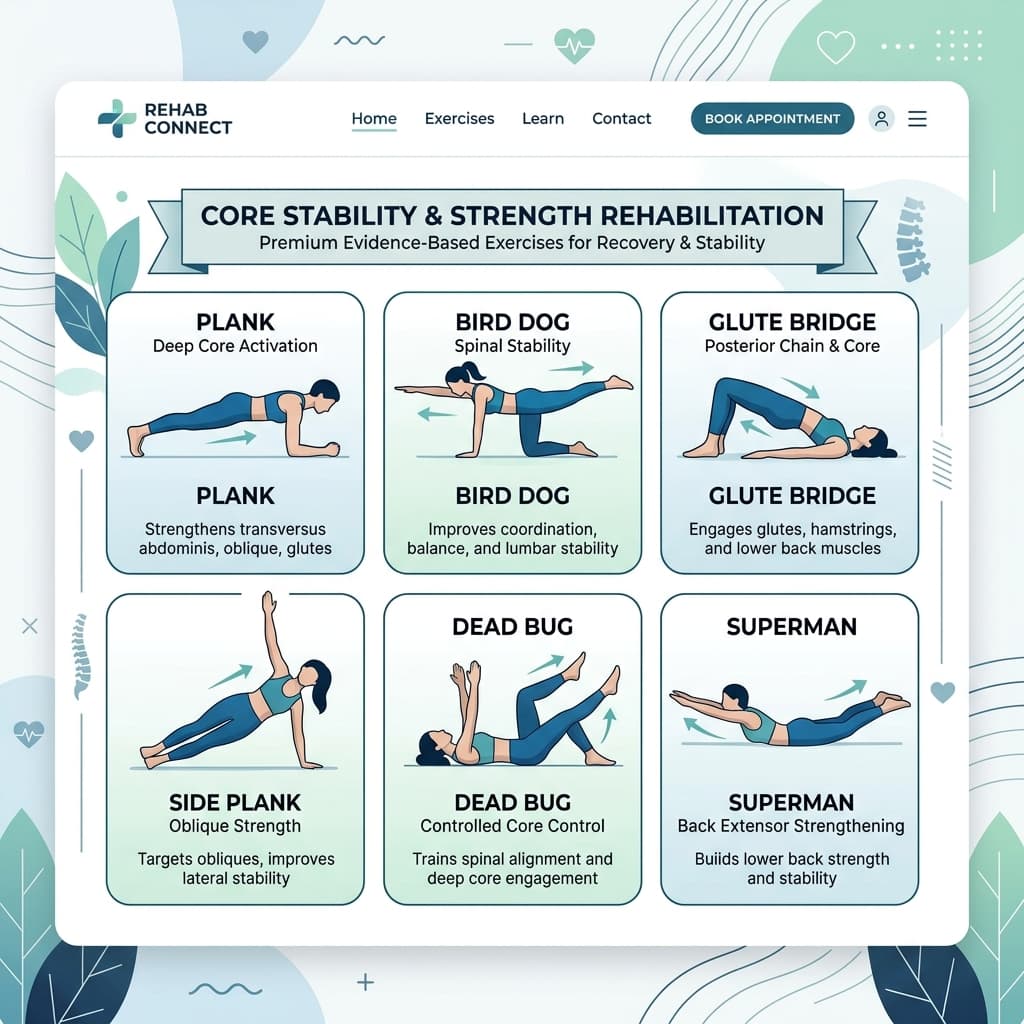
Strengthens the anterior and lateral core walls (transversus abdominis and obliques) to build endurance and prevent lumbar shearing.
Trains contra-lateral coordination and rotational control, reinforcing spine stabilization during limb movement.
Activates the posterior chain (glutes and hamstrings) to offload pressure from the lower lumbar segments.
Strengthens the erector spinae and back extensors to improve posture, structural resilience, and core balance.
Avoid holding your breath (Valsalva maneuver). Utilize continuous diaphragmatic breathing to stabilize intra-abdominal pressure.
Perform 5 slow, technically perfect repetitions rather than 15 fast, uncontrolled reps. Motor control retraining relies on strict alignment.
Soft tissue adapts to consistent stimulus. Doing your exercises 10-15 minutes daily is clinically superior to a single 90-minute session once a week.
Rehabilitation exercises are designed to challenge structures without overloading them. If you experience an increase in sharp pain, radiating numbness, tingling down your limbs, or joint locking, stop the exercise immediately and consult with your therapist for a program adjustment.
Every patient receives a customized movement prescription. Consult our clinical team to verify the correct volume, repetitions, and progressions for your pathology.