Accepting New Patients Every Day! Same-day & walk-in appointments welcome at all our clinics.Same-day & walk-in appointments welcome at all our clinics.
In neurological rehabilitation, few moments are more disheartening for patients and their families than reaching an unexpected plateau. Following an ischemic stroke, a traumatic brain injury (TBI), a motor vehicle concussion, or the onset of Parkinsonian tremors, standard rehabilitation often begins with immense hope. Yet, months into conventional physical therapy, gains frequently slow down. Spastic muscles remain locked in abnormal flexion synergies, foot drop persists during ambulation, sensory numbness lingers like a heavy fog, and debilitating central post-stroke pain resists routine pharmaceutical management.
For decades, standard medicine treated the adult central nervous system as a largely immutable structure. Once brain tissue was injured by ischemia or mechanical trauma, lost function was presumed permanent. Contemporary neuroscience has dismantled that dogma through the discovery of neuroplasticity: the brain's lifelong capacity to sprout new axonal collaterals, form novel synaptic connections, and unmask latent cortical pathways. The clinical dilemma, however, has always been how to effectively ignite that neuroplastic remodeling when conventional physical exercise alone fails to recruit dormant pathways.
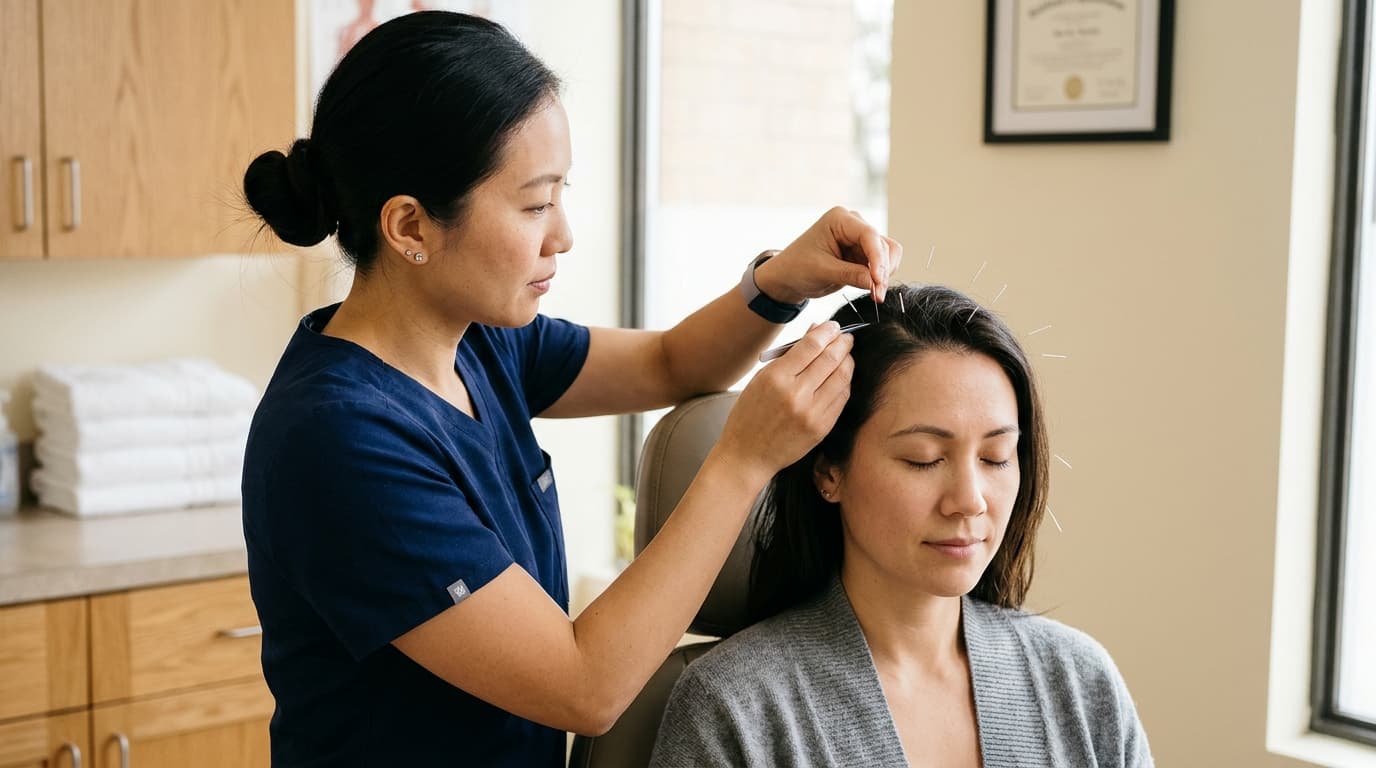
This is precisely where Cranial Acupuncture, also known in clinical literature as Scalp Acupuncture, Neuro-Acupuncture, or Zhu's Scalp Acupuncture, emerges as one of the most potent specialized interventions in modern neuro-rehabilitation. Rather than relying solely on distal acupuncture points on the limbs, cranial acupuncture accesses the cerebral cortex directly through somatotopic projections mapped across the anatomical layers of the human scalp.
Please note that due to the specialized clinical training, anatomical precision, and dedicated neuro-rehabilitation gym facilities required for this therapy, Cranial Acupuncture is available exclusively at Revive Rehab's Abbotsford clinic on Gladwin Road and our Surrey - Chimney Hill clinic on 72nd Avenue. Whether you are coordinating care with our acupuncture specialists in Abbotsford or accessing treatment through our Surrey acupuncture team, this clinical guide explores how cranial acupuncture operates, what peer-reviewed research reveals, and how our multidisciplinary protocols restore meaningful independence.
To comprehend why cranial acupuncture produces outcomes so distinct from general wellness acupuncture, one must understand its evolutionary development. While classical Traditional Chinese Medicine (TCM) texts dating back two millennia to the Huangdi Neijing documented cranial acupoints along the Governor Vessel (Du Mai), Gallbladder (Zu Shao Yang), and Urinary Bladder (Zu Tai Yang) meridians, modern cranial acupuncture represents a 20th-century synthesis of classical meridian theory and neurosurgical cortical localization.
In the early 1970s, neurosurgeons and acupuncture researchers in China, including Dr. Jiao Shunfa, Dr. Mingqing Zhu, and Dr. Toshikatsu Yamamoto in Japan (who developed Yamamoto New Scalp Acupuncture, or YNSA), began investigating whether stimulating scalp zones directly overlying specific cerebral functional areas could provoke therapeutic changes in the corresponding anatomical structures governed by those brain regions.
The breakthrough rested on Canadian neurosurgeon Dr. Wilder Penfield's famous 1930s discovery of the cerebral "homunculus" - the inverted neurological map of the human body projected across the primary motor cortex (precentral gyrus) and primary somatosensory cortex (postcentral gyrus). Penfield demonstrated that every voluntary muscle and sensory pathway in the body corresponds to a mathematically precise coordinate on the cortical surface of the brain, arranged upside-down: the feet and legs represented at the superior sagittal midline, the trunk and upper extremities along the middle portion, and the face, jaw, tongue, and speech apparatus represented along the lower lateral margins.
Pioneering clinical acupuncturists realized that the scalp tissues immediately overlying these cortical zones share rich embryonic, vascular, and neurochemical connections with the underlying cerebral tissue. By mapping therapeutic treatment lines across the skull that correspond to Penfield's homunculus, clinicians discovered they could awaken paralyzed limbs, downregulate hyperactive motor tremors, alleviate sensory paresthesias, and stimulate dormant speech centers with remarkable immediacy.
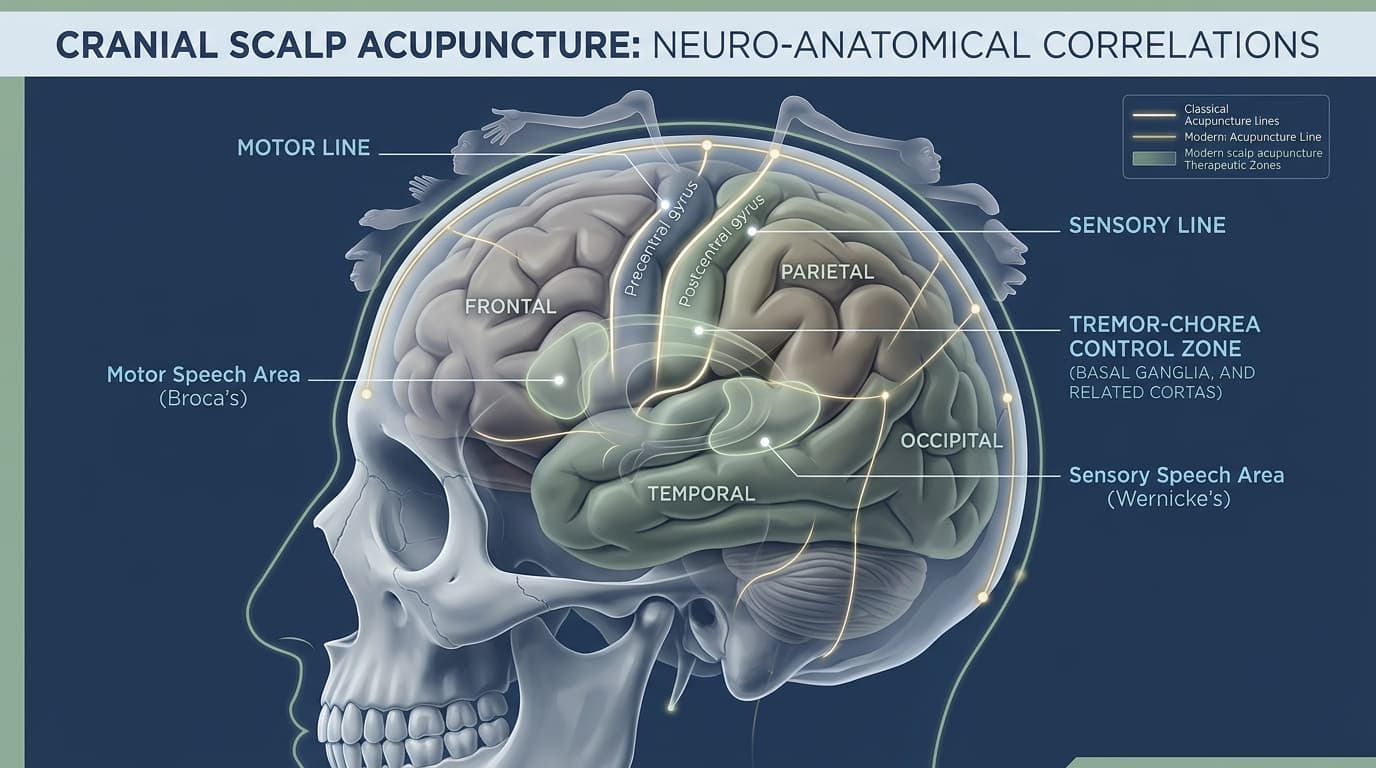
From an anatomical standpoint, performing cranial acupuncture requires meticulous technique that differs fundamentally from standard musculoskeletal acupuncture therapy or localized intramuscular IMS dry needling. The human scalp consists of five distinct anatomical layers, remembered through the surgical mnemonic S-C-A-L-P: Skin, Dense Connective tissue, Aponeurosis (Galea Aponeurotica), Loose subaponeurotic connective tissue, and Pericranium.
In classical body acupuncture, needles are inserted perpendicularly into muscular bellies. In cranial acupuncture, perpendicular insertion is avoided because the calvarial skull prevents deep penetration. Instead, an experienced acupuncturist introduces an ultra-fine, single-use, sterile filiform needle (0.25 mm to 0.30 mm in diameter) at a shallow 15- to 30-degree angle to the scalp surface.
The needle pierces through the skin and galea aponeurotica until the practitioner feels a distinct, subtle loss of mechanical resistance. This tactile feedback confirms that the needle tip has entered the fourth layer: the loose subaponeurotic space. Once within this pliable glide plane, the needle is advanced horizontally beneath the aponeurosis for 20 to 30 millimeters. Because the loose subaponeurotic layer contains minimal nociceptive pain receptors compared to the superficial dermis, properly placed cranial needles cause virtually no sharp pain. Patients often describe only a momentary prick upon dermal entry, followed by a sensation of mild warmth, gentle pressure, or a pleasant spreading heaviness known clinically as de qi.
The presence of emissary veins in this loose connective tissue plane is critical. These vascular channels connect the extracranial venous network directly with the intracranial venous sinuses and cerebral circulation, providing a physiological conduit through which mechanical and micro-electrical signals influence intracranial hemodynamics and neurochemical cascades.
At our Abbotsford clinic and Chimney Hill Surrey clinic, our registered acupuncturists locate cranial treatment lines using precise international anatomical surface landmarks measured from the sagittal midline (glabella to inion) and eyebrow-occipital line:
How can inserting fine needles beneath the scalp produce measurable improvements in brain function? Modern functional neuroimaging (fMRI), positron emission tomography (PET), and transcranial Doppler sonography have illuminated the biological mechanisms that occur during cranial acupuncture sessions:
Cranial acupuncture is a targeted neuro-rehabilitative modality designed for specific functional disorders. At Revive Rehab's Abbotsford and Chimney Hill facilities, our practitioners frequently employ cranial acupuncture for:
In conventional acupuncture, the standard patient experience involves lying motionless on a treatment bed in a dimly lit room with soft music playing for 30 to 45 minutes while needles remain stationary. While this passive approach is calming for general stress or local muscular tightness, it is fundamentally sub-optimal for complex neurological motor retraining.
At Revive Rehab's Abbotsford and Chimney Hill locations, we utilize the pioneering Functional Scalp Acupuncture protocol - associated with Dr. Mingqing Zhu's methodology and the classical concept of Dao Qi ("Guiding Qi Through Movement"). Under this model, cranial needles are not meant to keep the patient motionless. Instead, needles are inserted, stimulated with high-frequency rotational manipulation, securely anchored to the scalp, and kept in place while the patient actively performs physical rehabilitation exercises.
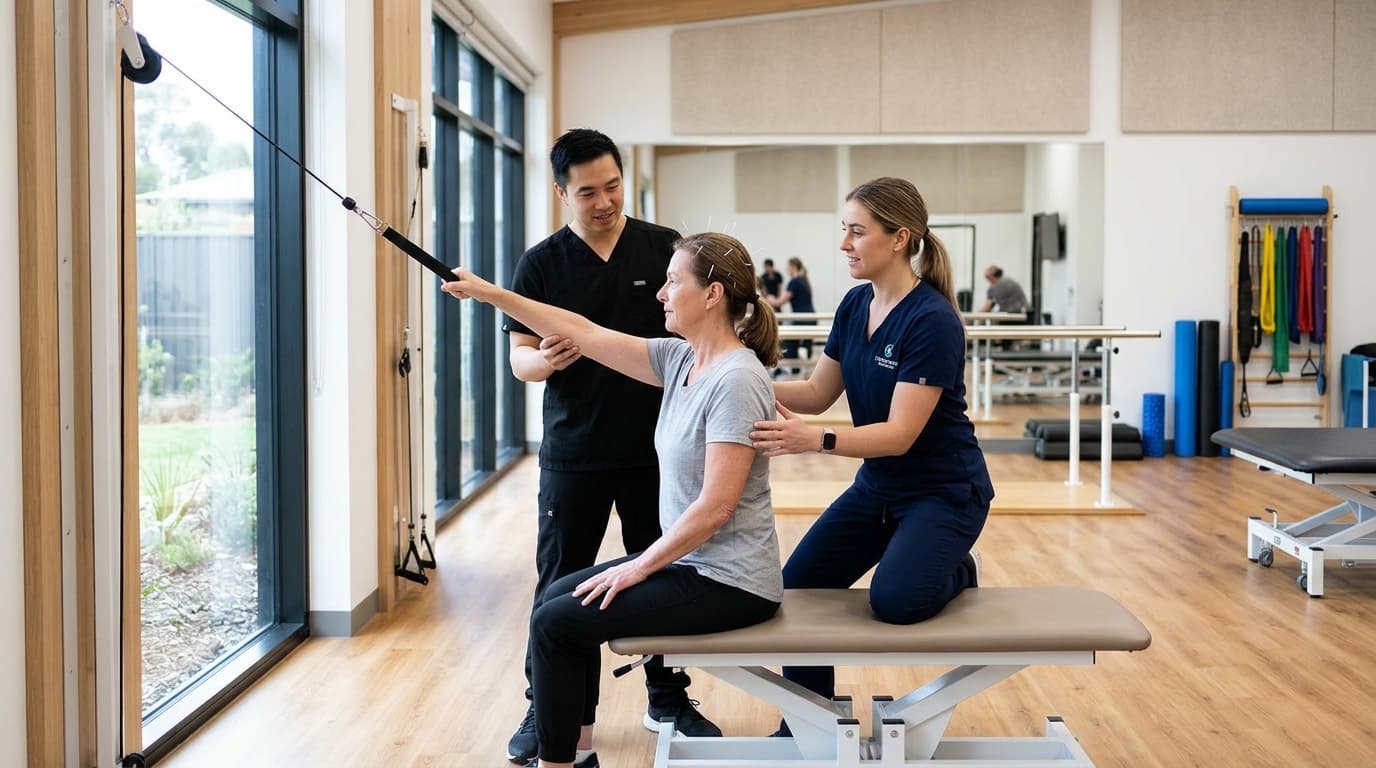
Why is this combination so clinically decisive? Neuroscience tells us that "neurons that fire together, wire together" (Hebb's Law). When our acupuncturist stimulates the Motor Line corresponding to the lower extremity, the motor cortex receives an intense volley of neurochemical and electrical activation. If the patient simultaneously engages in guided gait training on our rehabilitation floor, practices treadmill walking with body-weight support, or performs weight-bearing sit-to-stands alongside our physiotherapy team, the brain couples the external therapeutic stimulation with the voluntary internal motor intention. This dramatically accelerates neuroplastic reorganization compared to either intervention attempted in isolation.
For upper extremity recovery, patients perform targeted functional tasks, such as reaching for therapeutic rings, manipulating pegboards, practicing functional grasp-and-release drills, or using upper-body resistance pulleys, while the Motor and Sensory Hand Zones are stimulated. Even in cases where active movement is currently impossible due to complete flaccid hemiplegia, we integrate mental motor imagery (mirror therapy and mental rehearsal), commanding the patient to visualize moving the limb while the corresponding cranial zone is twirled.
If you or a loved one are considering cranial acupuncture for the first time, it is natural to wonder what an actual treatment looks and feels like. Here is a clear, step-by-step walkthrough of what occurs during a neuro-acupuncture consultation at our Abbotsford clinic or Chimney Hill Surrey clinic:
Patients frequently ask our clinical team how cranial acupuncture compares to other needling modalities offered across our clinics, such as Intramuscular Stimulation (IMS) / Dry Needling or traditional body acupuncture. While all three utilize sterile filiform needles, their anatomical targets, physiological mechanisms, and clinical indications differ fundamentally:
Honesty and clinical transparency are core values at Revive Rehab. Neurological rehabilitation is not an overnight fix; it is a progressive biological process of axonal sprouting, synaptogenesis, and motor relearning that requires appropriate therapeutic dosing.
For post-stroke and traumatic brain injury patients, the greatest rate of spontaneous neuroplastic recovery occurs within the first 3 to 6 months post-insult. Initiating cranial acupuncture during this acute-to-subacute window yields the most rapid functional breakthroughs. However, even for individuals who are 1 to 5+ years post-stroke or post-concussion and have been told they have "permanently plateaued," cranial acupuncture can frequently reignite dormant neural pathways, improve gait fluidity, reduce spastic contractures, and significantly elevate daily quality of life.
Because neuroplastic signaling requires repetitive reinforcement, a single isolated session is rarely sufficient. A typical evidence-based cranial acupuncture protocol consists of:
Every brain is unique, and progress depends on the location and extent of initial neural injury, patient age, general vascular health, and active participation in prescribed functional movement drills.
Cranial acupuncture achieves its highest clinical potential when integrated into a multidisciplinary framework. One of the greatest advantages of receiving care at Revive Rehab is our cohesive clinical model. Under one roof, our registered acupuncturists collaborate directly with our broader rehabilitation team:
We reiterate that Cranial Acupuncture is a specialized clinical modality available exclusively at two of our four Lower Mainland clinics:
(Note: While our Surrey - Scott Road and Langley - Willoughby clinics offer premier comprehensive physiotherapy, chiropractic care, massage therapy, and general wellness treatments, cranial acupuncture is specifically hosted at our Abbotsford and Chimney Hill locations.)
We believe accessing specialized neuro-rehabilitation should be as seamless and stress-free as possible. At both our Abbotsford and Chimney Hill clinics, we provide seamless direct billing for almost all major Canadian extended health benefit providers, including Pacific Blue Cross, Canada Life, Sun Life Financial, Manulife, Green Shield Canada, Desjardins, and Chambers of Commerce Group.
ICBC Motor Vehicle Accident Coverage: If your neurological symptoms, concussion, or whiplash resulted from a motor vehicle collision in British Columbia, ICBC pre-approves direct billing for acupuncture treatments within the first 12 weeks of your crash date, with zero out-of-pocket payment required for approved claims. No physician referral is needed to begin.
WorkSafeBC (WCB) & MSP: We also accommodate patients with accepted WorkSafeBC rehabilitation claims and facilitate billing for qualifying individuals under MSP Supplementary Benefits. For full details regarding deductibles and coverage limits, visit our comprehensive Insurance and Billing Guide or review our New Patient Guide.
Living with a neurological condition, post-concussive brain fog, persistent stroke deficits, or chronic intractable migraines can feel overwhelming and isolating. You do not have to accept that your current functional level is the end of your recovery journey. With cranial acupuncture and our dedicated multidisciplinary clinical team, new neurological pathways can be awakened, strengthened, and restored.
To schedule an initial cranial acupuncture assessment with our experienced registered practitioners, book online instantly through our JaneApp portal or contact our Abbotsford or Chimney Hill clinics directly. We look forward to partnering with you on your path to lasting physical freedom and neurological recovery.
Get trusted physiotherapy, rehabilitation and wellness resources from Revive Rehab more easily when you search on Google.
Your Google preferences are controlled by you and can be changed at any time.
Ready to experience evidence-based care? Our multidisciplinary practitioners are here to support your recovery goals.